Syncurrent
A learning platform delivering business education built for tribal communities in the United States, with sequenced courses, progress tracking, automatic certificates and a community for sharing ideas.
Business education a long drive from the reservation
Many federally recognised tribes run economic development offices and tribal enterprises, yet a tribal member who wants formal business education usually has to travel for it, to a community college far from the reservation, on a timetable that assumes they have nothing else to do.
The distance is only part of it. Programmes rarely reflect the specific context of tribal entrepreneurship, and the combination of family obligations and work schedules makes conventional course formats impractical for a significant portion of the community. The result is an access gap that has held for a long time.
Syncurrent was built to close it directly. The platform delivers structured business education, entrepreneurship, finance, marketing and operations, in a format tribal members can engage with on their own schedule and their own devices, with content that does not assume a corporate context they do not live in.
Content authority came before technology
The constraint that mattered most was not technical. The courses were not generic business modules licensed from a third party. They were developed specifically for tribal entrepreneurship, reflecting the regulatory environment of tribal enterprise, the role of sovereign economic development, and the practical realities of starting a business within a reservation-based community.
The platform's job was to carry that content with the rigour any curriculum deserves, sequenced modules, progress tracking, assessments, without wrapping it in a generic corporate aesthetic or vocabulary that would feel imported. Every interface decision was tested against one question: does this look and read like it was made for the people using it.
Courses, progress and a community in one place
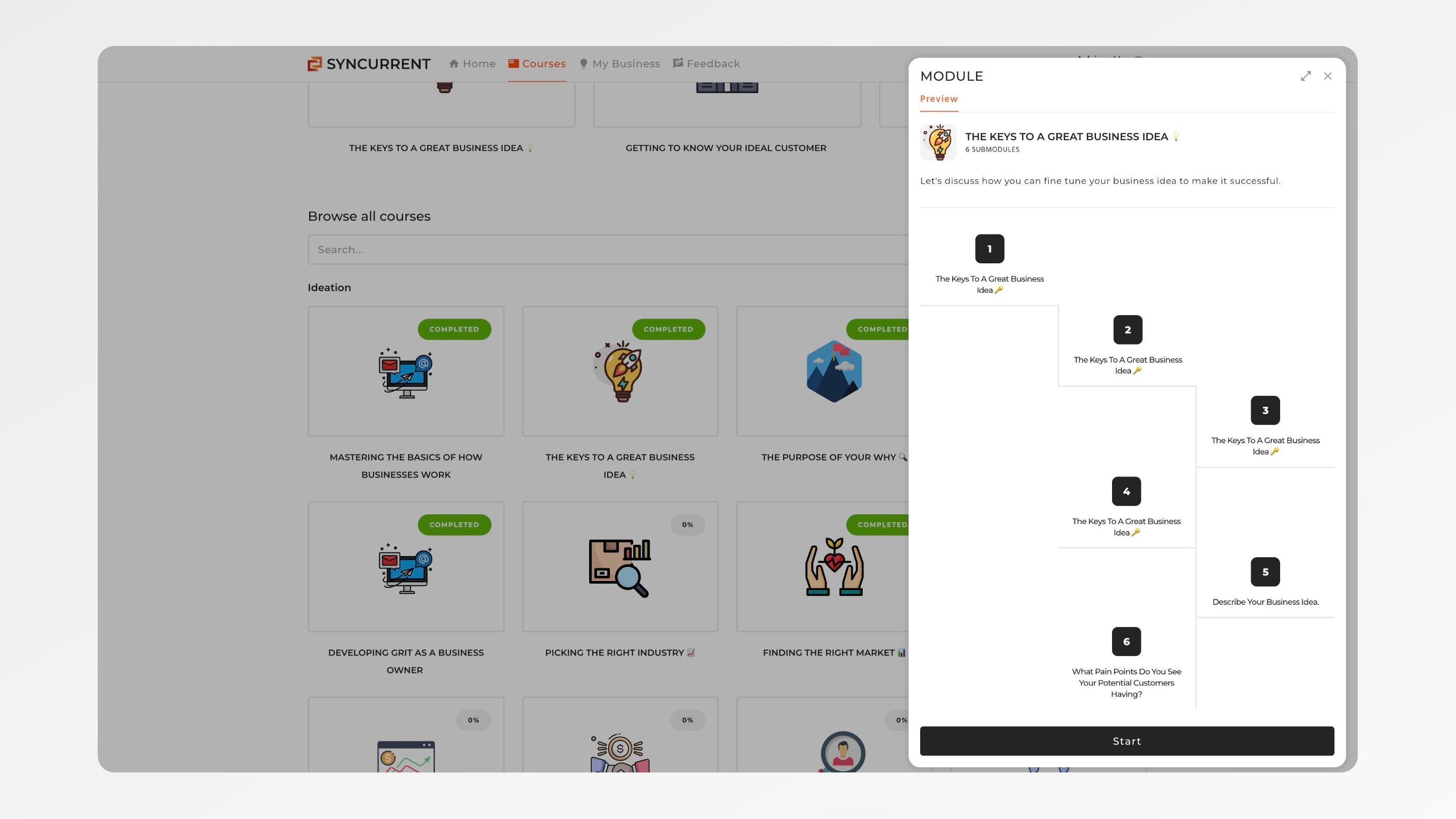
Courses are organised into modules with video content, written materials and a knowledge check at the end of each unit. Learners move through them in sequence and see their progress across every enrolled course from a personal dashboard. Completion certificates are generated automatically at the end of each course, so a learner has something to show without waiting for an administrator.
The community layer sits beside the courses. It is a space where learners share business ideas, ask questions and receive feedback from instructors and peers. Business development in this context is as much about network and accountability as individual knowledge, and the community was part of the value from the first conversation, not an add-on.
An admin interface lets instructors upload new courses, organise content and monitor learner progress across the full enrolment without technical involvement. The economic development offices commissioning the platform run it themselves.
Why build rather than configure an existing LMS
An existing learning management system, Teachable, Thinkific or a hosted Moodle instance, would have deployed faster, and we said so. Two things argued against it.
First, the community features. Existing platforms deliver courses well but offer limited community integration, and none that could be shaped to this context. Second, the signal the platform itself sends. A generic course platform signals generic content. A platform built specifically for this community signals that the content was built for them too, and that distinction mattered to the offices commissioning the work. The trade-off was a longer build and the responsibility of maintaining it. Against the alternative of content this specific arriving in a container this generic, that was the right cost to carry.
A learner's week on the platform
A learner logs in from a phone or a laptop, picks up the module where they left it, watches the video, reads the material and takes the knowledge check. The dashboard records the result and moves them on. When they finish a course, the certificate issues on its own.
Between modules they post a business idea to the community, or answer someone else's question. Instructors see the discussion and the progress data in the same admin view, so they know who is moving, who has stalled and where the questions cluster. Nobody is exporting spreadsheets of completions or emailing certificates by hand.
What tribal learners have access to today
Tribal members access structured business education in a format that fits around existing work and family schedules. Progress is tracked, certificates issue on completion, and the community layer keeps learners connected to instructors and to each other.
Courses that previously required travel to an off-reservation institution are now reachable from any device. The platform also gives the economic development offices something they did not have before: a curriculum they own, an enrolment they can see, and a place to publish the next course when it is ready.
Start a project.
Book a call or send a brief. The engineers who would build it read everything.