Serees | FabShop
A bilingual landing page for Serees FabShop, a metalworking manufacturer in Monclova, Mexico. Capabilities, tolerances and certifications on one page, so international buyers can qualify the shop and enquire in English.
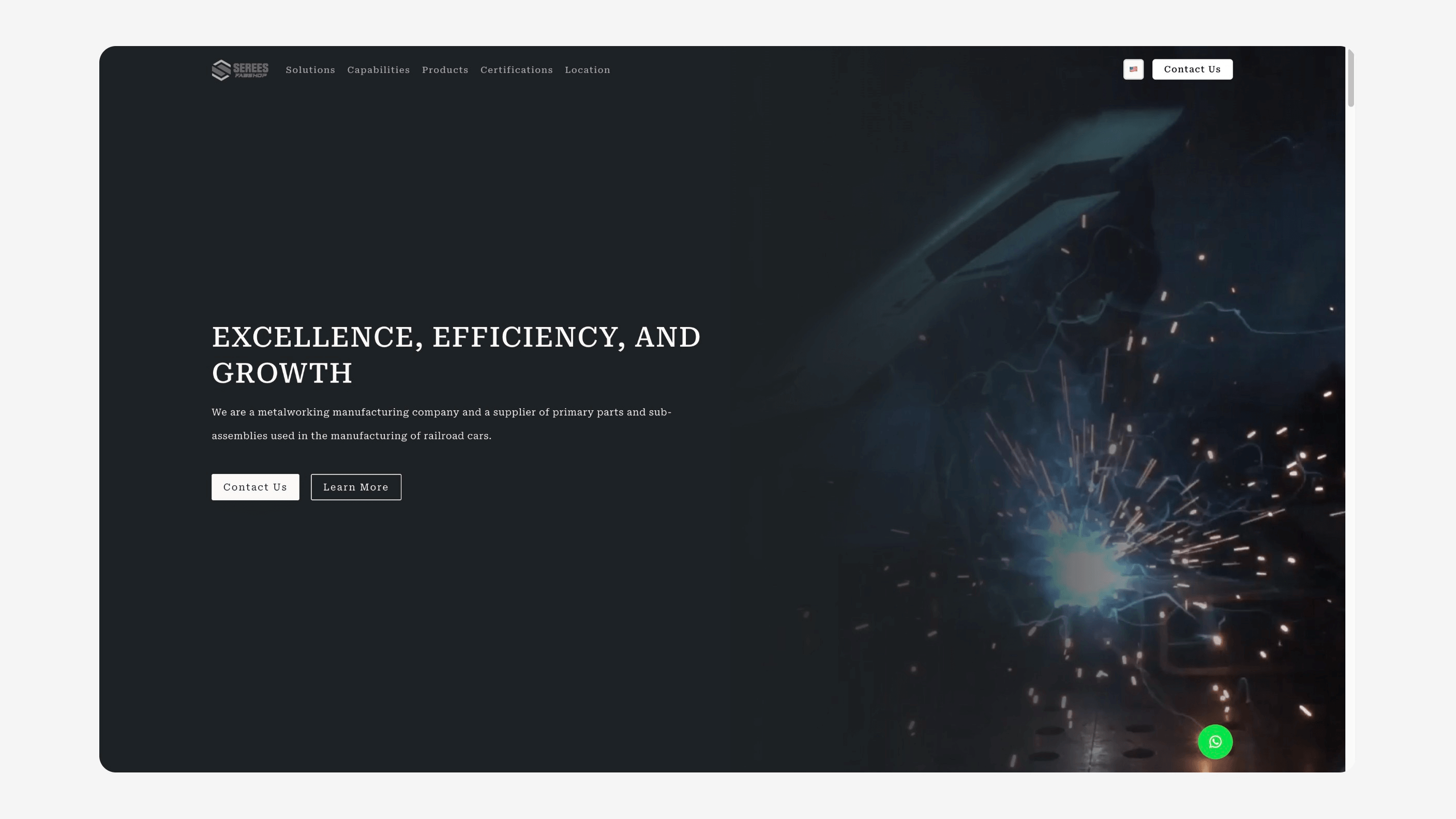
Manufacturing capability with no international presence
Serees FabShop is a metalworking and fabrication manufacturer in Monclova, Mexico, producing custom components for industrial, commercial and construction applications. Its clients came through domestic trade networks and referrals, a model that worked locally and put international contracts entirely out of reach. A buyer in the United States or Canada looking for a fabrication partner would search, find nothing, and move on.
Serees had the capacity and the capability to compete for that work. What it lacked was any way to be found by the people placing it. Referrals do not cross borders on their own, and a shop with no searchable presence is, to a foreign procurement team, a shop that does not exist.
The second problem was language. What web presence there was existed only in Spanish. Industrial procurement in North America runs in English, and a page the target buyer cannot read is functionally invisible to them, however good the work behind it.
A multilingual site that had to convert, not just inform
The constraint was that the page could not simply describe what Serees did. It had to make a buyer who had never heard of the company confident enough to make first contact. Industrial procurement carries real stakes: lead times, material specifications, quality standards, certifications. A buyer contacting an unfamiliar fabricator is taking on risk, and the page had to reduce that perceived risk rather than list capabilities and hope.
That shaped both content and structure. Certifications and quality standards had to be prominent. Example work had to show the complexity and scale the shop handles. The contact path had to be low-friction, a form rather than a phone number in a foreign country code that a buyer would hesitate to dial.
Language added its own constraint. Industrial terminology has to be exact, because a mistranslated tolerance or process name reads as incompetence to the single reader who matters. Machine translation was ruled out for that reason.
A landing page that answers the buyer's question
The page runs in Spanish and English. A language toggle preserves the visitor's position on the page when they switch, so a bilingual buyer checking a term in the other language does not lose their place. Both versions are genuine translation written for the sector, not automated rendering.
The capabilities section is organised around the types of work Serees handles, laser cutting, bending, welding and finishing, with specifications and tolerances listed for each process. Materials handled, maximum dimensions and available certifications sit alongside. A buyer who needs to know whether Serees can meet a specific requirement finds the answer without making a call.
Project examples show completed work with basic specifications: material, process, application. The contact form captures the buyer's requirements in structured fields, material, quantity, required process, timeline, so the Serees team can respond with a relevant first message rather than a generic reply asking for details the form already collected.
Why a single focused page over a full company website
A full website covering company history, team, equipment list and case studies would have been more comprehensive, and it is what most manufacturers build. The problem is the buyer. Someone arriving from a search or a referral has a single question, which is whether these people can do the job in front of them, and they will give the page a short time to answer it.
A single page that answers that question clearly and immediately converts better than a site that requires navigation to find the relevant information. Everything that supports the answer, capabilities, certifications, example work and contact, sits on one page in the order a buyer needs to see it.
What was given up is the long tail: the equipment list nobody reads before first contact, the history page that matters only after trust exists. Those belong to a later conversation, not to the page whose job is to start it.
How an enquiry arrives now
A buyer searches for a process and a material, lands on the English version of the page, and checks the tolerances against their drawing. They look at a comparable completed job. They fill in the form with material, quantity, process and timeline, and submit.
On the Serees side, the enquiry arrives already structured. The team knows what is being asked before replying, quotes against real requirements, and no longer spends the first exchange extracting basic specifications by email in a second language. Spanish-speaking domestic clients use the same page and the same form; the toggle is the only difference.
Nothing was added to the shop floor. What was added is a front door that the international buyer can open.
What the page delivers for Serees
Serees now has a professional English-language presence that did not exist before. International buyers who find the company through search or referral meet a clear capabilities presentation and a structured way to enquire. The page handles both the language barrier and the credibility question that any unfamiliar fabrication supplier faces with a new buyer.
The foundation is a bilingual page whose content is maintained once and rendered in both languages. When capabilities change, the page changes with them, in Spanish and English, and the enquiry form keeps producing leads the team can act on without a second exchange.
Start a project.
Book a call or send a brief. The engineers who would build it read everything.