LiveStockReady
A livestock marketplace that records who owns each animal, when ownership changed hands and when the holding period clears, so farmers can sell beyond their own network with a verifiable chain of custody.
Sales that ended with a handshake and a receipt
Livestock in the regions LiveStockReady serves has always changed hands through in-person auctions, agricultural shows and whoever a farmer happened to know. A seller with cattle to move reached their immediate network, posted in a local farming group, or waited for the next market day. The buyers were whoever turned up. Ownership was proven by a paper receipt, if it was proven at all.
Each of those limits compounds the others. Price discovery is slow because reach is small. Reach is small because the market is physical. And the record of the sale lives in a glovebox, which is fine until someone needs it.
Regulation adds a dimension the informal market handled badly. Many livestock categories carry a holding period: once an animal is purchased it may not be moved or processed until a set number of days have passed. In a peer-to-peer sale between farmers, with no central system, remembering that obligation was left entirely to the parties involved. Nobody was checking.
The animal, not the sale, had to be the record
The constraint that shaped the architecture was not the marketplace. It was ownership and holding period tracking. In a system handling regulated categories, the platform has to know who owns each animal, the moment ownership transferred, and whether the holding period has been satisfied before anyone can schedule a fulfilment event.
That rules out the standard e-commerce data model, where an animal would be a line item on an order. An animal needs to be an individual record with its own ownership chain, carrying every event that has happened to it. The marketplace, the part buyers and sellers see, was built on top of that ownership layer rather than the other way round.
Getting this wrong is not a usability problem. It is a compliance problem, discovered at the worst possible moment. So the ownership layer was designed first and the trading experience was fitted to it.
Listing, purchase, holding, fulfilment
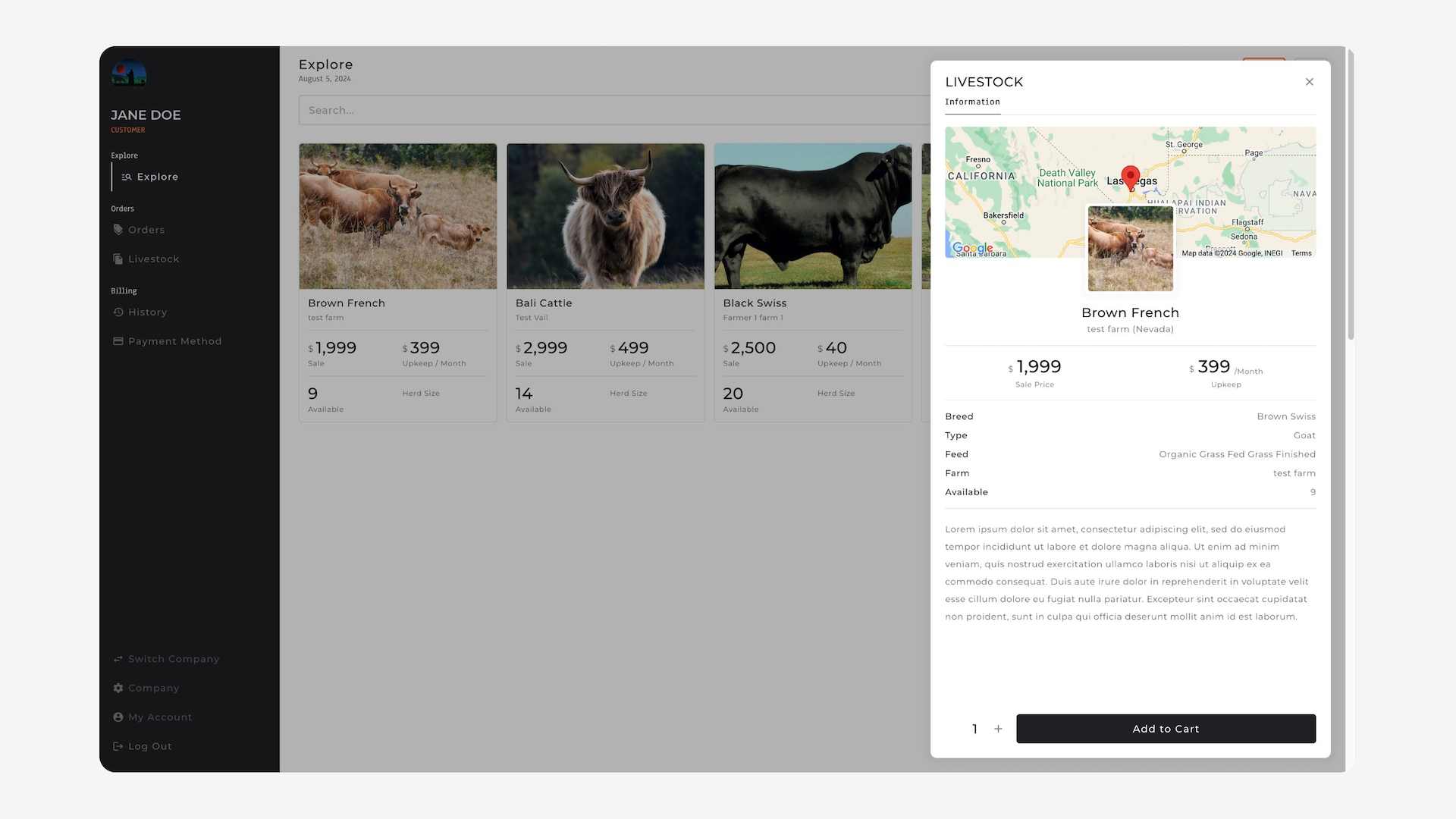
Sellers list animals with category, age, weight and any certifications. Buyers browse and purchase, paying through Stripe. At the point of payment, ownership transfers to the buyer and the platform writes a timestamped transfer record against that animal. There is no separate step to confirm; the payment is the transfer.
For categories with a holding period requirement, the system calculates the earliest eligible fulfilment date from the transfer timestamp and the regulatory requirement for that category. Fulfilment, whether collection or delivery, can only be scheduled once that date has passed. Both seller and buyer see the holding period status in their own dashboards, counting down from the same clock.
When fulfilment is confirmed, the ownership record updates again with the fulfilment date and any documentation attached. The full chain, from listing through purchase, holding period and fulfilment, is stored per animal and readable end to end.
Why one record per animal and not one per transaction
The simpler approach records at the transaction level: this sale, this buyer, this date. It works for ordinary marketplaces, where the thing sold has no history that matters after checkout. It was the obvious choice, and it was rejected.
An animal can be bought, held and resold before its original holding period is satisfied. Under transaction-level tracking, the second sale looks like any other sale. The clock that governs whether the animal may be moved started at the first transfer, and nothing in a transaction table points back to it. The obligation becomes invisible until it becomes a problem.
Individual animal records with a full event history make that chain visible and verifiable. Each transfer is an event on the animal's timeline, and the earliest eligible date is computed from the right origin however many times the animal has changed hands. The cost is a more involved data model and more careful handling of edge cases. The benefit is that the platform can answer the only question a regulator asks.
What a sale looks like now
A seller photographs the animal, fills in category, age, weight and certifications, and publishes. Buyers anywhere on the platform can find it, not only those within driving distance of a sale barn. The listing looks the same to a buyer in the next county as it does to one across the state.
The buyer pays. From that moment the platform does the work: ownership moves, the transfer is timestamped, and the earliest fulfilment date is calculated for the animal's category. Both dashboards update. When the date arrives, the buyer schedules collection or delivery, the seller confirms, and the record closes with the fulfilment date.
Neither party maintains a calendar of holding periods, a folder of receipts or a running note of who owns what. The paperwork that used to be the whole compliance system has been absorbed into the record.
A chain of custody that follows the animal
LiveStockReady launched in Missouri, its US launch market, with the marketplace and the ownership layer live together. Farmers and buyers trade without being limited to their own geographic network. Ownership transfers record automatically at purchase. Holding period eligibility is calculated and displayed with no manual tracking from either side.
The paper receipts and personal memory that once constituted ownership documentation have been replaced by a digital chain that follows each animal from listing to final fulfilment. Because that chain exists per animal rather than per sale, it holds up across resales and can be read back at any point. That is the foundation everything else on the platform sits on.
Start a project.
Book a call or send a brief. The engineers who would build it read everything.