Abigail
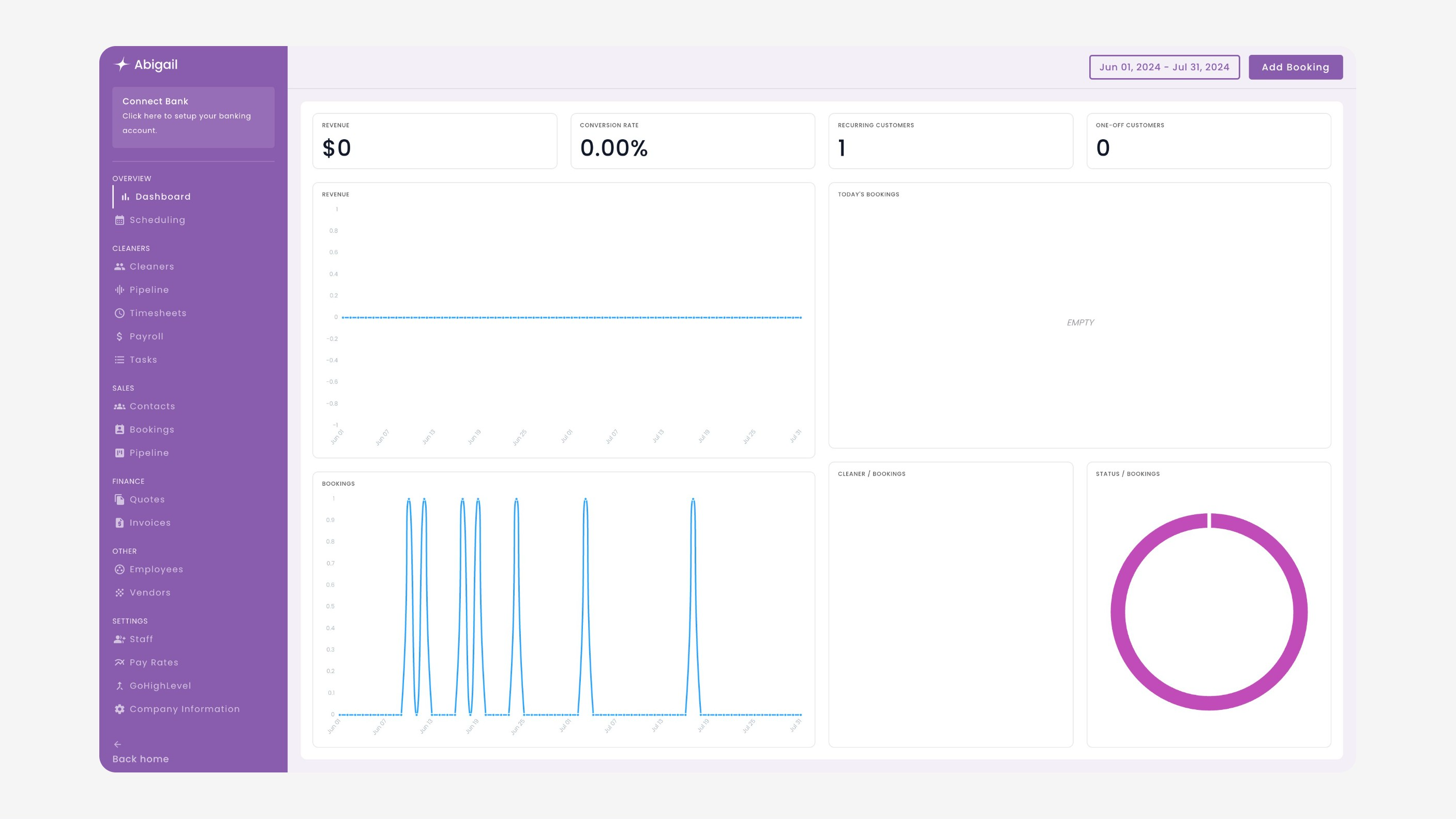
An operations platform for cleaning companies that puts scheduling, live cleaner locations, job completion and invoicing in one system, so the manager runs the day from a screen rather than a phone.
An operation held together by one person's phone
A professional cleaning company is a coordination problem before it is a cleaning problem. Cleaners have to be assigned to jobs, someone has to know whether they have started and finished, clients have to be invoiced once the work is done, and every day brings a change: a cleaner calls in sick, a client reschedules, an address turns out to be wrong. At small to medium scale, almost all of that runs on phone calls, WhatsApp messages and a spreadsheet.
The failures are predictable because the system is informal. A job nobody confirmed. A cleaner at the wrong address. A client invoiced for a full visit that ran short. None of these is dramatic on its own; together they are the reason the owner ends up as the person holding everything in their head.
That is also the reason the business stops growing. The owner's capacity to coordinate becomes the ceiling, and adding cleaners adds coordination faster than it adds revenue. Abigail was built for a New York cleaning company at exactly that point.
Knowing where everyone is, without asking
The requirement that shaped the build was real-time location visibility. An operations manager needs to know, at any moment, which cleaners are at which jobs, whether they have arrived and whether the job is running to time. Without that, every exception starts with a phone call and a wait: the cleaner running late, the client asking when someone will turn up, the job that has to be reassigned because someone is stuck.
Location was therefore not an optional feature layered on a scheduling tool. It was the primary operational instrument, and scheduling, completion and invoicing were designed to hang off it. The question was never whether to track location; it was how to do so in a way the manager could trust.
Cleaners, jobs, locations and invoices in one model
Each cleaner has a profile holding their availability, their assigned jobs and, when they are active, their current location. The scheduling interface lets the manager assign cleaners to jobs, set arrival windows and see the entire day across all staff in a single view. Gaps and overlaps show up before they become problems.
When a cleaner starts a job they log in to the app, which triggers a location check-in. From then on the manager sees which cleaners are active, where they are and how long they have been on site. Completion is logged in the same interface. The job's timeline, from assignment to arrival to finish, is recorded as a matter of course.
Invoicing follows completion automatically. When a job is marked complete, the client receives an invoice based on the job type and duration, and payment status is tracked in the platform. Late payments flag themselves, so the manager is not maintaining a separate tracker to know who owes what.
Why passive location beat a status button
The alternative was a status system: cleaners tap en route, arrived and completed, and the manager reads the taps. It is simpler to build, lighter on the cleaner's device and easy to explain. For a while it looked like enough.
The weakness is that a status is only as good as the memory of the person setting it. A cleaner who forgets to tap arrived leaves the manager with nothing, and the moment that matters most, when a client is asking where their cleaner is, is exactly when a busy cleaner is least likely to be looking at their phone. Location tracking is passive. It captures where the cleaner is without a deliberate act at each stage, so the information the manager sees does not depend on anyone remembering.
The trade is a heavier reliance on the device and a clear understanding with staff that tracking runs only while a job is active. That was accepted, because visibility that fails silently is worse than no visibility at all.
A morning in the platform
The manager opens the day's schedule and sees every cleaner and every job laid out in one view. Assignments are set, arrival windows are attached and the day is published. As cleaners log in at their first jobs, their positions appear on the same screen.
When a client calls to ask where their cleaner is, the answer is on the screen. When someone is running late, the manager sees it before the client does and can reassign or warn ahead. When a job finishes, the completion is logged by the cleaner and the invoice goes out without anyone drafting it.
The team no longer confirms jobs by message, chases arrival times by phone, writes invoices at the end of the day or reconciles payments against a list. WhatsApp still carries conversation, because people talk, but operational decisions are made from what the platform shows rather than from what someone last said.
The manager's day, without the phone calls
Scheduling, cleaner location, job completion and invoicing now flow through a single system. The operations manager has a live view of where every cleaner is and what every job is doing without making a call. Invoicing is automatic and payment tracking is current without manual reconciliation.
The coordination ceiling that capped the business has moved. Because every job produces its own record of assignment, arrival, duration and payment, the company has a clean operational history to plan against, and the owner is no longer the only place the whole picture exists.
Start a project.
Book a call or send a brief. The engineers who would build it read everything.