Construct CRM
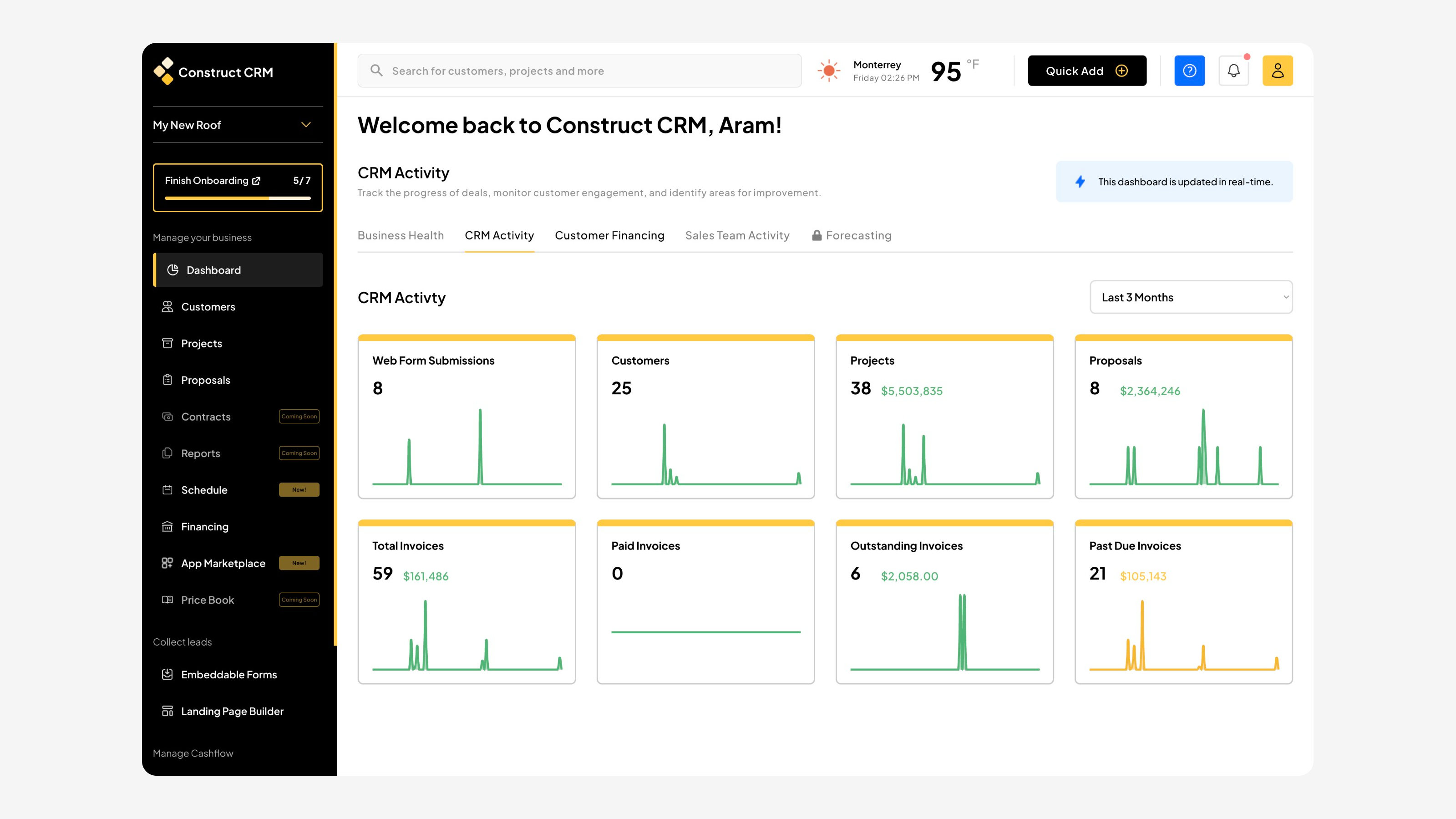
A CRM built for construction teams that keeps the customer record and the project record together, from first quote to final handoff, with $4M of project pipeline managed inside it.
Customer promises lost between sale and delivery
A construction company is never working on one job. It is quoting one, building another and handing over a third, and the customer on each is being managed through email threads, a notes app and whoever happens to remember what was said.
The damage shows at handoff. Jobs are sold by one person and delivered by another, and the project manager taking over rarely has a clean view of what was promised during the sale: the scope items agreed verbally, the delivery dates committed to, the concerns the customer raised and was reassured about. When those promises do not travel with the job, the customer notices first and the margin goes second, spent on rework and goodwill that nobody quoted for.
The client came to us running exactly that pattern across overlapping projects, coordinating materials, subcontractors and inspections on all of them while the relationship side of the business lived in memory.
Two workflows that had to share one record
The constraint that shaped the build was that customer management and project delivery could not be separate tools. The handoff was where things went wrong, and fixing the handoff meant the data on either side of it had to be one thing: the customer record and the project record, connected from the first conversation to the final invoice.
That is a data-model decision before it is a feature decision. The customer and the project had to be modelled as fundamentally linked, not as two entities that reference each other across two systems and drift apart the moment someone updates one and forgets the other.
A CRM and a project tracker on one data model
Each customer record connects to that customer's active and historical projects. The project record holds the timeline milestones, task assignments, subcontractor notes and cost tracking against the original quote. When a project manager opens a job, the sale conversation, previous jobs and any special commitments sit alongside the current status. Nothing has to be requested from the salesperson.
Workflow automation triggers at defined stages. A completed milestone notifies the customer. A task approaching its deadline flags to the project manager. A payment due date generates an invoice through Stripe. The sequence is configurable per project type, so a new-build workflow can carry different triggers from a renovation or a repair job without anyone maintaining separate tools for each.
Cost tracking sits against the quote rather than in a spreadsheet somewhere else, so the margin position of a job is visible in the same place as its schedule and its customer history.
Why one data model instead of integrating two tools
The alternative was to integrate an existing CRM with an existing project management tool. Both categories are mature and the integration is technically feasible. We recommended against it.
An integration depends on data passing correctly between two systems, and any gap in that handoff is invisible until a mistake surfaces under live conditions, usually in front of a customer. A single data model with one source of truth for the customer-project relationship removes that class of failure entirely. It is also simpler for a non-technical team: one login, one interface, one place to look. The trade-off is that the team gave up the deeper feature sets of two specialist tools. For the way they work, the connection mattered more than the depth.
A job from quote to final invoice
A job begins as a customer record with a quote attached. The salesperson logs the conversation, the scope items and any commitments as they are made. When the job is won, the project record is created from that same customer, and the project manager inherits the full context on the first day.
From there the automation carries the routine. As milestones complete, the customer is told without anyone drafting an email. As tasks near their deadlines, the project manager is warned before they slip. As payment dates arrive, invoices go out through Stripe and their status comes back into the project record. The team no longer keeps a separate list of who needs an update, who needs chasing and what was promised in the sale.
What the team manages today
The platform manages $4M in active project pipeline. Project managers take over jobs with the customer context intact. Milestone notifications and invoice generation run without coordination from the team.
The customer record that started with a sales conversation stays live through delivery and into any future work with the same customer. Because every job is written to the same model, the company's history with each customer accumulates as a single account rather than a scatter of threads, and the next quote starts from what the last project actually cost.
Start a project.
Book a call or send a brief. The engineers who would build it read everything.