WoPa
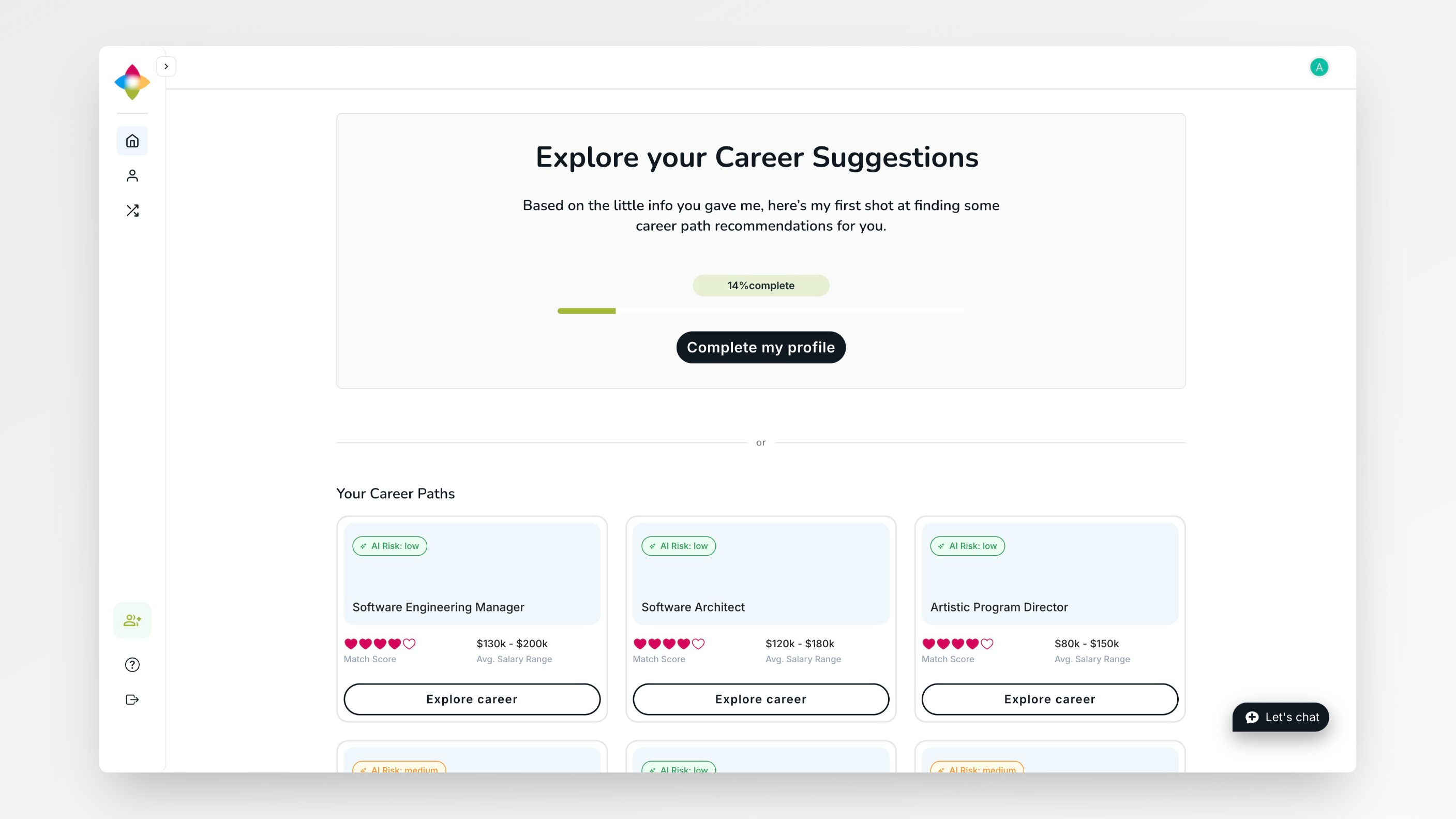
An AI career platform that takes people from an uncertain starting point to a ranked shortlist of practitioners worth talking to, through a branching questionnaire and an OpenAI reading of their answers.
Guidance from people who do the work
WoPa addresses a specific gap in career development. Most people weighing a career move cannot reach a mentor who actually works in the field they are considering. Career advisors are expensive or oversubscribed, and practitioners willing to give their time are hard to find. The mentorship platforms that exist are mostly directories: browseable lists with no way of telling whether a particular professional is right for a particular person's situation, goals or stage.
The founder's view was that the most useful career conversations are not with career coaches. They are with practitioners who can describe what the work actually feels like day to day and whether that matches what the person wants. The problem was never the conversation. It was finding the right practitioner without wasting the time of everyone on both sides.
Useful answers for people who do not know the question
The hardest design problem was ambiguity. A platform that asks "what career are you interested in" and shows professionals in that field is straightforward to build. WoPa's premise is that many users arrive genuinely uncertain. The questionnaire had to produce something useful for a person with a clear direction and for a person still working out what they want, using the same flow.
The matching logic faced the same constraint from the other side. It could not fall back to a generic list when the input was vague. It had to surface professionals who were specifically relevant to each user's profile, which meant the profile itself had to hold more than a job title.
A branching questionnaire and a ranked shortlist
The questionnaire runs as a branching flow. The opening questions are broad: interests, working style, values, what the user is trying to change. Each answer narrows the path that follows, so the sequence differs from one user to the next. At the end, OpenAI processes the accumulated answers and produces a career direction analysis. It is not a single recommendation but a structured read of what the responses suggest about the user's priorities and which types of roles or industries align with them.
That analysis drives the ranking. Every professional on the platform has completed a structured profile: background, current role, industry, the kinds of conversations they find useful, and the type of person they are best positioned to help. The matching engine weights the AI's analysis of the user against each professional's self-described context and returns a ranked list rather than a category page.
Users browse their matches, read full profiles and send a connection request. The professional receives a summary of the user's questionnaire output alongside the request, which is enough context to decide whether the conversation would be worth both people's time. The platform launched in Palo Alto.
Why an AI reading beat a category taxonomy
The alternative was a taxonomy: tag user responses with career categories, tag professionals the same way, surface the intersections. It is deterministic and easy to audit, and it would have been quicker to build. The weakness is that career interests do not map cleanly onto fixed categories. Someone whose answers point toward creative autonomy, high-stakes decisions and direct contact with users might fit across three different industries. A category match would return one of them and hide the rest.
OpenAI's output holds several dimensions at once and produces a reading that a fixed classification cannot replicate. The cost is that the analysis is less predictable than a lookup table, which is why it is shown to the user as reasoning rather than as a verdict, and why the professional sees the same summary before accepting.
From first question to first conversation
A user opens the questionnaire and works through it in around 8 minutes. The analysis arrives with a ranked list of professionals beside it. They read the profiles that interest them and send a request, and the professional decides with the user's summary in front of them.
Nobody at WoPa curates matches by hand, screens requests or writes introductions. The questionnaire gathers the context, the model interprets it, the engine ranks against it, and the request carries it forward. Each professional who joins and completes a profile widens what the engine can match against.
What users and professionals experience today
A user completes the questionnaire in around 8 minutes and receives a career direction analysis alongside a ranked list of relevant professionals. Connection requests arrive with enough context that professionals find them worth answering, and the acceptance rate on requests sits above 60%.
The platform has processed thousands of questionnaire completions since launch. Because the ranking is computed against each professional's profile rather than a fixed category list, match quality improves as the professional database grows, without the questionnaire or the engine needing to change.
Start a project.
Book a call or send a brief. The engineers who would build it read everything.