Elements
A mobile app for smart-meter households in Israel that turns daily energy use into goals, rewards and neighbourhood challenges, so consumption falls because people keep looking at it.
Smart meters that nobody opened
Smart meters had reached a growing share of Israeli homes, and almost nobody was looking at them. Households checked their consumption when a bill arrived and looked wrong, then forgot about it until the next one. The data existed. The habit of reading it did not.
That gap is the whole problem with energy monitoring as a product category. Providers can make consumption visible, but visibility on its own does not change what a household does in the evening when the heating and the oven are both running at once. Behaviour shifts when people have a reason to check, something to check against, and a reward for getting it right.
Elements was built to supply those reasons. The premise was simple: structure energy monitoring as a daily engagement loop, with check-ins, visible progress against a personal goal, rewards for reduction and comparison with similar households, and people will open the app in a way they never open a provider's dashboard. Lower consumption at scale is the outcome. An app worth opening every day is the mechanism.
The app was the pitch
The founders were raising a $150K seed round while the product was still being built, and the mobile app was the primary artefact investors would judge. There was no separate deck to hide behind. The app had to look complete, feel finished and demonstrate the full engagement loop convincingly enough that someone who had never thought about energy behaviour could see why a household would come back tomorrow.
That set the quality bar at production from day one and removed the usual room to iterate in public. A rough prototype would have been read as a rough business. So the build ran with a single rule: the app that went in front of investors would be the same app that went to users, with no separate demo branch and no features that only worked on stage.
A daily loop built on meter data
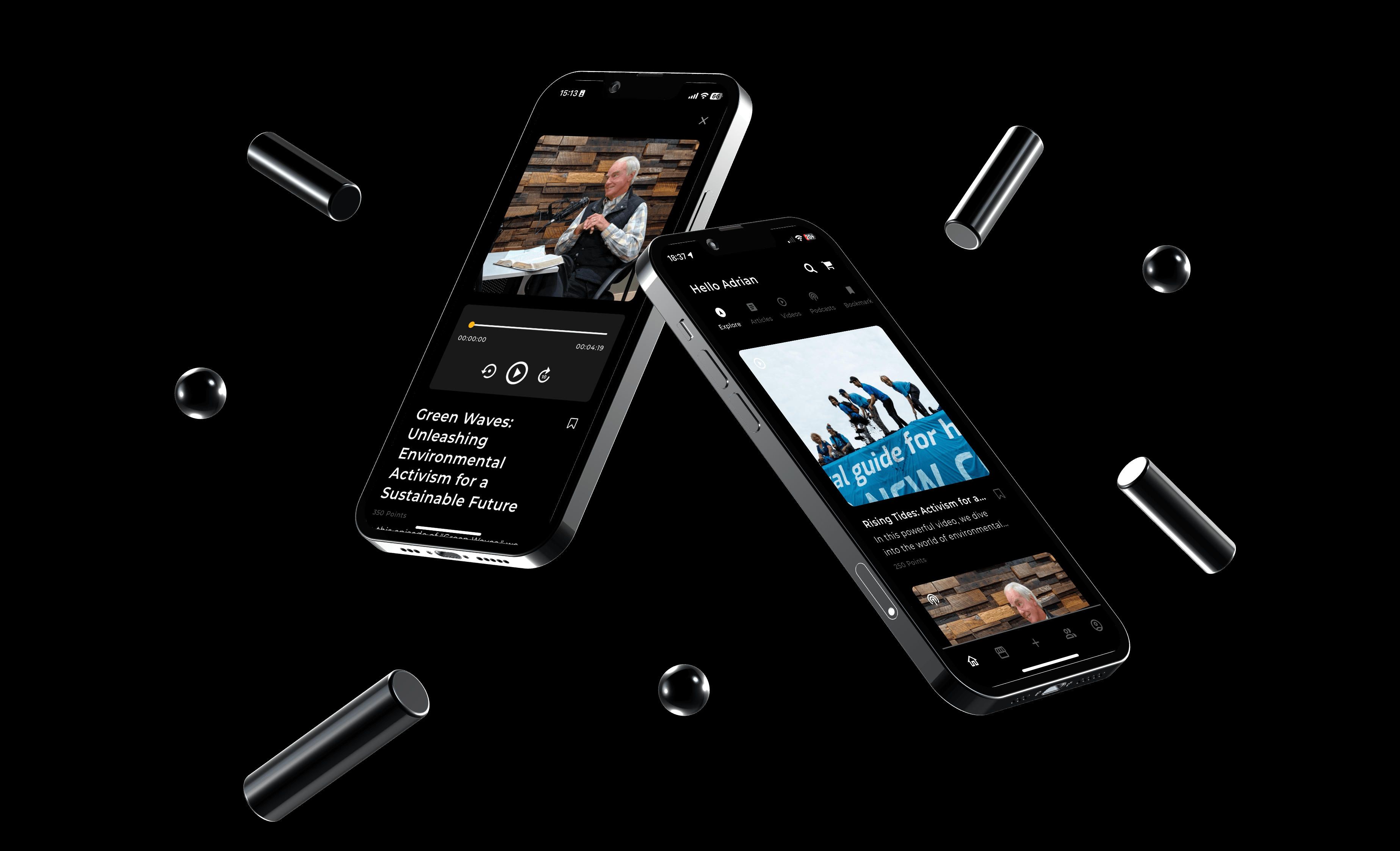
The app connects to the household's smart meter and shows consumption in real time and over history. Every user has a personal baseline derived from their own past usage, and each day carries a reduction target measured against it. Meet the target and the day earns points. Points accumulate toward rewards, vouchers, discounts and partner offers, redeemable inside the app without leaving it.
An education layer sits beside the numbers. Short pieces explain what typically consumes the most in a home, offer practical ways to cut it, and translate the user's savings to date into an environmental equivalent they can picture. The content is not the same for everyone. It adapts to the consumption profile the meter reveals, so a household whose usage peaks overnight reads different material from one whose peak is in the morning.
Community features close the loop. Users see how their consumption compares with similar households and can join neighbourhood challenges, where collective reduction earns group rewards. The comparison gives the personal goal context; the challenge gives it company.
Why a game rather than a better dashboard
Energy providers already ship monitoring dashboards, and a more attractive one was the obvious thing to build. The research on energy behaviour change points the other way, and it points consistently: information alone does not move usage patterns, while visible progress toward a goal and social comparison do. Gamification was therefore the product decision itself, not a layer applied afterwards to make a chart friendlier.
The rejected alternative would have produced a marginally better version of what already existed, with no reason for anyone to open it on an ordinary Tuesday. The daily target, the points and the neighbourhood comparison are what give the meter data a reason to be read, and that reading is what the reduction depends on. Remove the game and you remove the habit, and with it the outcome the company exists to deliver.
A day inside Elements
A typical user opens the app in the morning and sees yesterday's result against the baseline, and whether the target was met. If it was, the points are already there. Today's target is set automatically, calculated from the baseline rather than chosen by the user, so there is nothing to configure and nothing to forget.
Meter data arrives without any action on the user's part. Progress toward rewards, movement in the household comparison and standing in any active neighbourhood challenge all update on their own. Content is chosen for the user rather than browsed. The only deliberate acts are the check-in and, when the points are there, the redemption, which is exactly the amount of effort a daily habit can carry.
For the company, the loop runs without manual intervention. There is no content to hand-pick per user, no reward to reconcile by hand and no comparison to compute offline. The founders' attention goes to partnerships and to reading what the engagement data shows.
Funded on the strength of a live product
Elements launched in Tel Aviv with the full loop live: monitoring, daily goals, rewards and community challenges, all in the production app. The $150K seed round closed on the back of that app, evaluated as working software rather than as a promise.
The first cohort engaged with the daily goal feature at a rate that validated the premise the product was built on: give people a reason to look at their consumption and they will look. The company now has a behaviour-change loop running on real meter data, an education layer that adapts to what the data shows, and a community mechanic that turns individual reduction into something a neighbourhood does together.

Start a project.
Book a call or send a brief. The engineers who would build it read everything.