ARC English
An AI-led placement platform for ARC English that reads, listens to and hears each candidate, then places them on the CEFR scale with written reasoning tutors can act on. Live in 3 weeks.
Placement tests that candidates walked away from
ARC English runs language programmes for non-native speakers preparing for the UK job market, and every programme begins with a placement decision. The written test that made that decision was losing candidates before they finished it. More than 40% dropped out part-way through, and each of them was an enrolment that never happened. The test also measured only one thing. It could grade reading comprehension well enough, but it was blind to spoken ability, so two candidates could score identically on paper and perform very differently in conversation.
Tutors saw the consequences in the first week of every cohort. Misplaced candidates had to be moved between groups mid-programme, and the coordination cost of doing that landed on the same coordinators who were trying to run the intake. The team had no view of where in the test people were giving up, or why, which made the drop-off impossible to fix by editing the questions.
Twenty-one days before the next intake
ARC had a new intake opening in three weeks. The previous cohort had been placed by hand: coordinators ran informal phone interviews, took notes and made judgement calls. The results were reasonable, but the process cost several days of staff time per cohort and could not grow with enrolment. It also produced no record a tutor could check later.
The deadline was not aspirational. The coordinators had already stopped scheduling manual interviews in anticipation of the new system, so the platform had to be in production and handling real candidates before the intake date. That ruled out a long discovery phase and any feature that did not directly serve the placement decision.
Four formats, one rubric, a written rationale
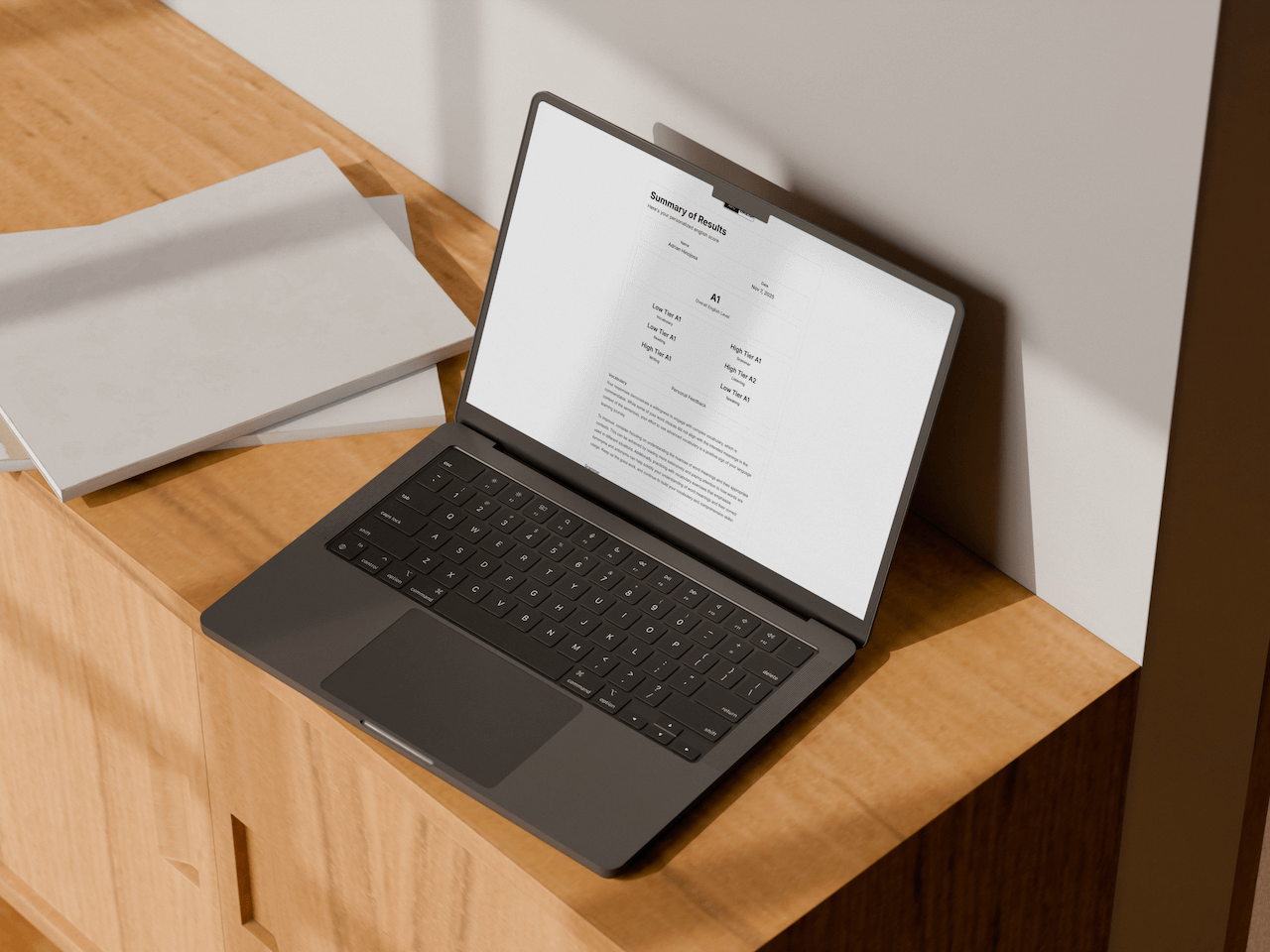
The platform moves each candidate through four formats across three exercise types: short reading passages with comprehension questions, audio clips with structured response prompts, and a spoken exercise captured in the browser and transcribed with Speech-to-Text. Every response is collected into a single record and passed to OpenAI, which applies a rubric mapped to CEFR levels, the international standard for language proficiency. The output is a placement band and a written rationale explaining which evidence pointed to that band.
Tutors access a dashboard that shows each candidate's band, the model's reasoning and the raw inputs behind it, including the transcript of the spoken exercise. Every decision is auditable. When a tutor disagrees, they override the band, and the override is logged so the rubric can be recalibrated between cohorts rather than argued about in the moment.
The interface is fully responsive, because candidates take the assessment on whatever device they have. It also carries one specific design idea: people perform worse when they know they are being assessed. Questions appear one at a time. There is no visible progress bar and no countdown timer. The experience is closer to a guided exercise than an exam, and that pacing made a measurable difference from the first live cohort.
Why reasoning rather than a points total
The simpler build was a points-based system: mark the correct answers, total the score, map the total to a band. It would have shipped sooner. The trouble is that written accuracy and spoken fluency do not track together reliably. A candidate who scores well on multiple choice may build spoken sentences that fall apart under pressure, or show the reverse profile entirely. A points total flattens those differences into a single figure and hides the reason for the placement.
A reasoning model evaluates coherence, vocabulary range and grammatical accuracy together, the same dimensions a human examiner weighs at once. When it is wrong, it is wrong in a legible way: the rationale shows which evidence was over-weighted, and a tutor can correct the band with a clear record of why. A rubric that only outputs a number offers nothing to correct.
A cohort placed without a single interview
A candidate receives a link, opens it on a phone or laptop and works through the exercises at their own pace. When the last response is submitted, the analysis runs and the band lands on the tutor dashboard with its rationale attached. Nobody at ARC schedules a call, takes notes or types up a judgement.
Tutors open the dashboard before a cohort starts, read the reasoning for each placement and adjust where their judgement differs. What used to be an informal note from a phone interview is now a structured record that the next tutor can also read. The coordinators who once spent days on placement now spend that time on programme delivery.
What ARC operates with now
Candidates complete placement in under 12 minutes with no staff involvement. The first cohort through the platform finished at a 78% completion rate, up from 60% on the written test it replaced. Week-one misplacement flags have dropped significantly, and every placement arrives with reasoning a tutor can read, question and override.
The whole system went from idea to production in 3 weeks. Because every override is logged against the evidence that produced the original band, the rubric now has a feedback loop that improves calibration between cohorts, and the platform can absorb larger intakes without adding a single interview to anyone's calendar.

Start a project.
Book a call or send a brief. The engineers who would build it read everything.