Aldea Bienes Raices
A native mobile platform for Aldea Bienes Raíces that puts a curated set of Mexican properties in front of buyers, with real filters, direct enquiries and a realtor CRM behind every listing.
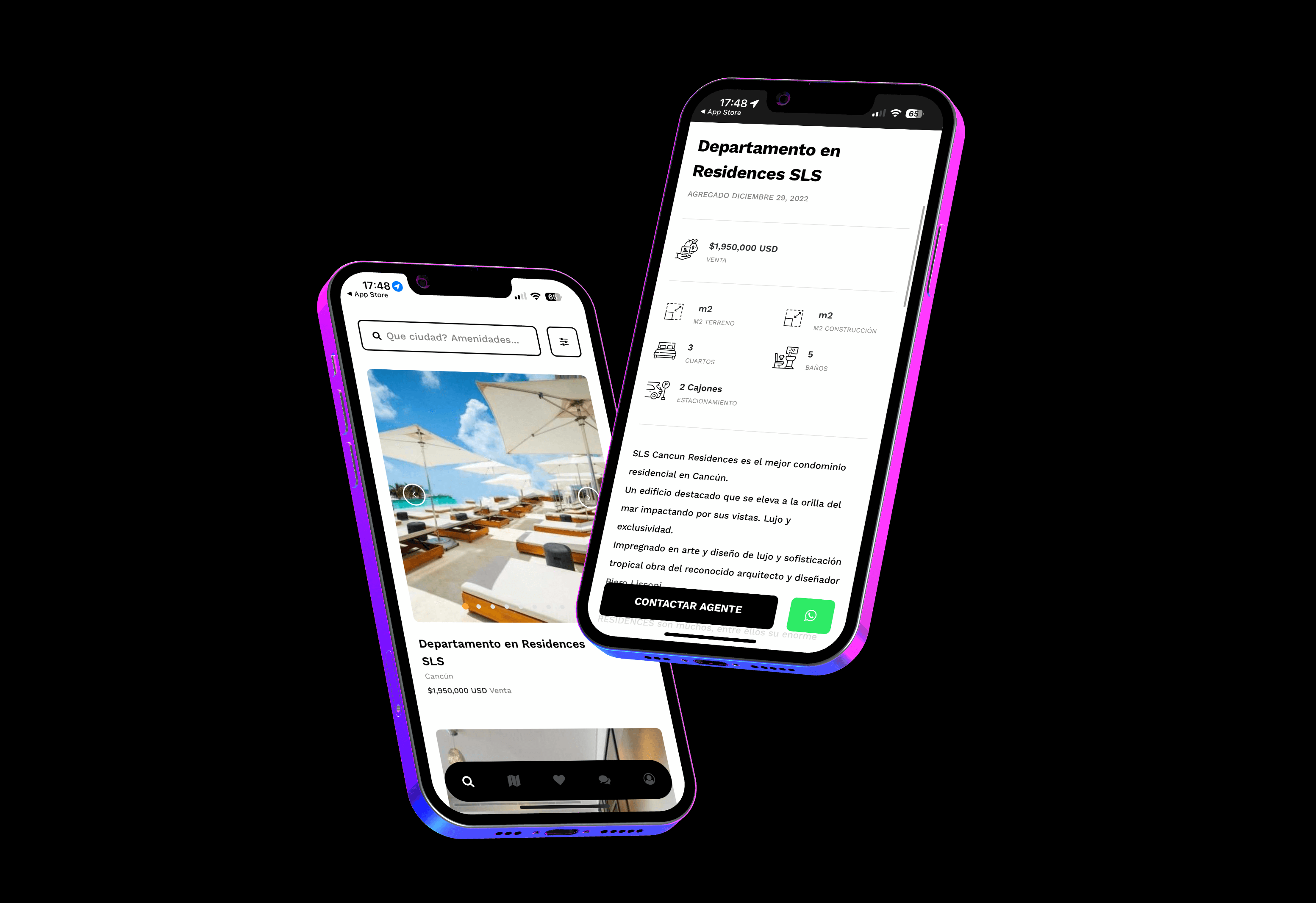
Property browsing that didn't match how buyers searched
Aldea Bienes Raíces curates residential property across selected regions of Mexico and connects buyers with the realtors who represent each listing. Before the mobile platform, that operation ran between a static website and a WhatsApp-heavy process for routing interested buyers to agents. The site showed listings, and little else.
There were no meaningful filters. Budget range, property type and location, the things a buyer narrows on first, were absent from the browsing experience. A buyer who did enquire was dropped into an informal message chain rather than a structured process, and routing them to the right agent depended on whoever happened to pick up the thread.
The friction showed in the conversion rate. Buyers left without enquiring, and those who did were hard to route efficiently. The thing that set Aldea apart, a selective catalogue rather than an aggregation of everything on the market, was invisible in the experience. A curated listing browsed through a bare website looks exactly like an uncurated one.
Mobile because Mexican buyers shop on a phone
The platform had to be built for mobile from the outset. Mexican property buyers, particularly in the demographics Aldea was targeting, browse property on their phones. The research, the shortlist and the first agent contact all happen there. A desktop-first site that adapted poorly to a small screen was not an inconvenience; it was a conversion problem, and the platform had to match the reality of how the search is actually done.
That constraint reached the realtor side too. Agents managing enquiries, updating listing status and talking to buyers are rarely at a desk. They needed a mobile workflow rather than an admin panel they could only use at the end of the day, which pushed the build towards a single native app serving both audiences instead of a consumer app paired with a web back office.
Launching in San Miguel gave the first release a defined region and a defined set of agents, so the listing set and the routing rules could be tested against a real market rather than a hypothetical one.
A curated listing platform with a CRM layer behind it
The buyer-facing experience is built around browsing with real filters: location, price range, property type, number of bedrooms, and whether the property is for sale or for rent. Each listing carries a photo gallery, key specifications and a description structured around what makes the property distinctive rather than a generic feature list.
An enquiry goes directly to the listing's assigned agent and opens a contact record in the realtor's CRM. Before the first conversation, the agent sees the buyer's profile: which properties they have viewed, which they have saved, and what their stated criteria are. Follow-up is managed from the same app, so the history of a buyer relationship lives with the agent who owns it rather than in a personal chat thread.
Listing management sits with the Aldea team in an admin interface. A new listing is uploaded with photos, assigned to an agent and published to the buyer-facing app. Assignment at publication is what makes the routing automatic later; every enquiry already has an owner the moment it arrives.
Why curation over aggregation
The temptation in any property platform is to show as many listings as possible. More inventory means more search results, which should mean more enquiries. Aldea's positioning was the opposite: a smaller set of properties that meet a quality threshold, presented carefully, and the browsing experience had to say so.
That ruled out the endless-scroll catalogue. Fewer results per search, more information per listing, and filters designed to help a buyer narrow rather than to surface volume. It also meant intake stayed deliberately in the team's hands; listings are added through the admin interface, not pulled in from feeds, because the moment inventory arrives automatically the threshold stops being a threshold.
The trade-off is real. A curated catalogue will always look thin next to an aggregator's. The bet was that a buyer who finds fewer, better-matched properties and gets a prepared agent on the first call enquires more readily than one who scrolls a long list and is met with a cold reply.
A day in the app for a buyer and an agent
A buyer opens the app, sets a location and a price range, and filters by type and bedrooms. They save the listings that interest them and enquire from the listing itself. Nothing is copied into a chat; the enquiry carries the listing, the buyer and their saved history with it.
On the agent's phone, the enquiry appears against a contact record that already shows what the buyer has looked at. The agent replies with context, and the conversation can carry on over WhatsApp, which still handles the talking. What the app now holds is everything around the conversation: the profile, the saved properties, the status of each enquiry.
The Aldea team no longer forwards enquiries by hand or asks agents to reconstruct what a buyer wanted. Listing status is updated by the agent in the app, so the buyer-facing catalogue stays current without a separate publishing step.
What realtors and buyers use today
Buyers browse a curated set of properties with real filters, enquire directly from a listing and enter a contact relationship with the assigned agent. Agents manage enquiries, buyer profiles and listing updates from the same native app. The discovery, enquiry and CRM layer that was missing before now runs on the platform.
The foundation is a dual-interface product in which the realtor side and the buyer side share the same listings and the same contact records. Adding a region means adding listings and agents; the filters, the routing and the profiles already work.
Start a project.
Book a call or send a brief. The engineers who would build it read everything.